Requirements Analysis
Due to the remote location and inconvenient transportation of certain key areas, along with their long perimeters and extensive coverage, the response time from alert to on-site intervention by duty personnel in the event of an intrusion is often prolonged. Therefore, there is a need to implement early warning and layered protective measures along the perimeter. To address this, KONWER introduces the Integrated Radar-Vision Intelligent Perimeter Security System Solution. This system can detect targets such as vehicles and crowds, provide early warnings upon detection, predict the scale and direction of the targets, and take appropriate warning or intervention measures when necessary.

Construction Objectives
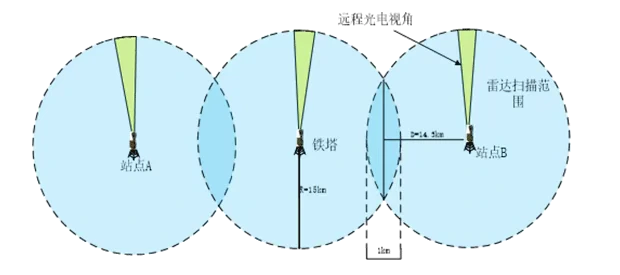
The construction objectives of the Integrated Radar-Vision Intelligent Perimeter Security System are "early warning, extended defense zones, multi-technology integration, and zonal configuration." By deploying the system in a relayed, blind-spot-free manner along the perimeter, the system aims to achieve comprehensive awareness and monitoring of key area perimeters after implementation. It addresses early warning challenges for ultra-long perimeters, reduces the probability of false alarms, erroneous alerts, and missed alerts, and enables intelligent detection, visual alert management, and automated operations through integration with front-end video systems.
System Composition
The Integrated Radar-Vision Intelligent Perimeter Security System consists of a one-dimensional phased array radar, a long-range electro-optical pan-tilt unit, protective cameras, transmission subsystems, and display and control subsystems.
1. The radar employs solid-state active phased array technology, suitable for target detection in complex environments, distance aggregation, altitude calculation, speed fitting, and extracting target trajectories. It balances broad-range azimuth scanning and airspace coverage capabilities. Through a one-dimensional servo pan-tilt unit integrated with the long-range electro-optical pan-tilt unit in a coaxial design, the system achieves blind-spot-free, obstruction-free, high-precision guidance and target positioning.
2. The long-range electro-optical pan-tilt unit integrates multi-spectral detection modules such as high-definition visible light cameras and cooled thermal imagers. Additional modules such as laser rangefinders, positioning navigation, electronic compasses, automatic tracking, and intelligent analysis can be optionally added to achieve all-weather, round-the-clock, multi-dimensional target discovery, positioning, tracking, identification, and tracing capabilities.
3. The protective cameras primarily address close-range monitoring blind spots of front-end equipment, providing supplementary surveillance and protection.
4. The transmission subsystem mainly includes wired fiber-optic transmission and wireless microwave transmission.
5. The display and control subsystem mainly comprises backend site monitoring stations, sub-control centers, and higher-level command and control centers. The site monitoring station deploys client hosts to display and control individual sets of front-end equipment. The sub-control center is equipped with clients, servers, operational devices, and decoding equipment, among others. The client is installed with security prevention and control platform software, integrating management, control, and display functions. The server primarily fuses and processes radar target data and electro-optical pan-tilt target data while storing evidence collection information. The higher-level command and control center can receive data pushed by the sub-control center.
The sub-control center deploys security prevention and control platform software, which can receive data from the radar and electro-optical systems. It provides real-time data display based on an embedded GIS system and control operations for various devices, displaying target trajectories and videos, and enabling video recording and playback.
System Advantages
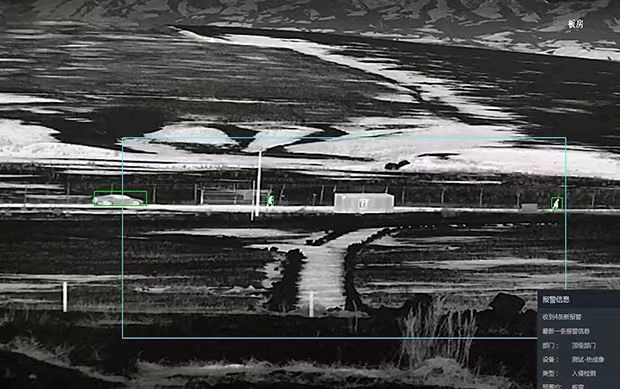
The radar-electro-optical integrated security prevention system boasts strong detection and monitoring capabilities, relying on radar scanning to detect targets and guiding electro-optical systems to identify and confirm intrusion targets. With a high level of intelligence and significant unmanned operation capabilities, it effectively reduces labor costs. The combination of radar detection for target discovery and electro-optical secondary target confirmation significantly lowers false alarm rates and improves the efficiency of security protection and effective intervention.
Building on the integration of radar and electro-optical detection systems, the system fully utilizes AI intelligent technology. Through intelligent analysis functions, it achieves capabilities such as search and early warning, video surveillance, target tracking, classification and identification, and threat assessment for key areas.
In this system, the radar and electro-optical systems adopt an integrated coaxial design, with advantages including:
1. Reduced calibration difficulty, ensuring the precision and effectiveness of radar-electro-optical coordination.
2. No obstruction between the radar and electro-optical subsystems, eliminating monitoring blind spots.
3. Avoidance of the need for segmented area compensation due to separate deployments.
Effect Demonstration
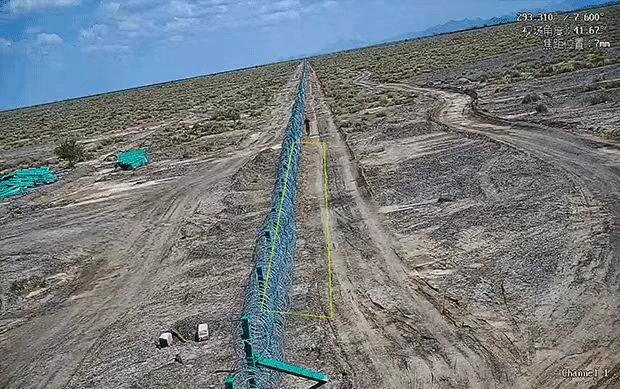
Intrusion Detection in Key Venue Areas

Copyright © 2026 by KONWER Technology Co., Ltd. All Rights Reserved